Thursday, July 2, 2015

On a mission to save our music

Båliphonics

Sri Lankan born Dr. Sumudi Suraweera, from the University of Canterbury, New Zealand talks to The Nation about his research on Sri Lankan Low-Country traditional drumming
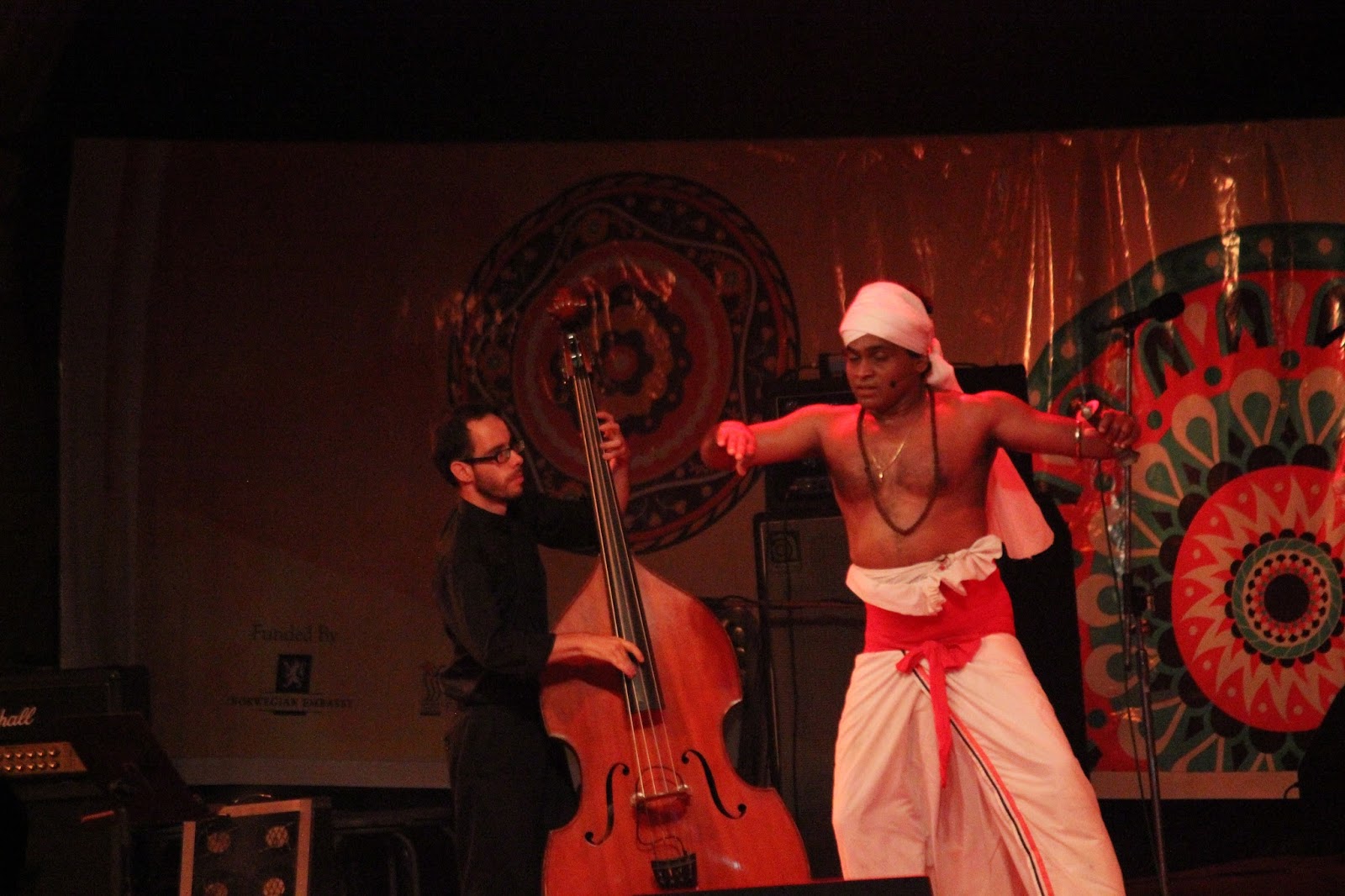

Baliphonics at JMF Pic by Sakuna M Gamage 


Sri Lanka is one of the few countries with a very vast and rich cultural diversity. The culture is itself very unique and thereby contributes to the Sri Lankan identity. Ancient customs, traditions and rituals hold great significance. Among these Bali, Thovil, and Shanthi Karma have been integral parts of Sri Lankan culture from pre-Buddhist era, which nurtured dark arts for thousands of years. Although, even if the remains of such rituals are practiced in almost all parts of the country, its survival is not guaranteed. 
  
These rituals are believed to serve specific purposes. Based on this point, one may argue whether it’s righteous to practice these rituals without a specific cause. “In fact this is one of the major criticisms we get,” says the founder of the Båliphonics group Dr. Sumudi Suraweera. Båliphonics presents the music of the low-country Båli ritual tradition of Sri Lanka in a sublime collaboration with contemporary jazz and improvisation. Båliphonics group is a part of Musicmatters collective. Established in 2010, Musicmatters introduced an alternative model for Western music education in Sri Lanka.
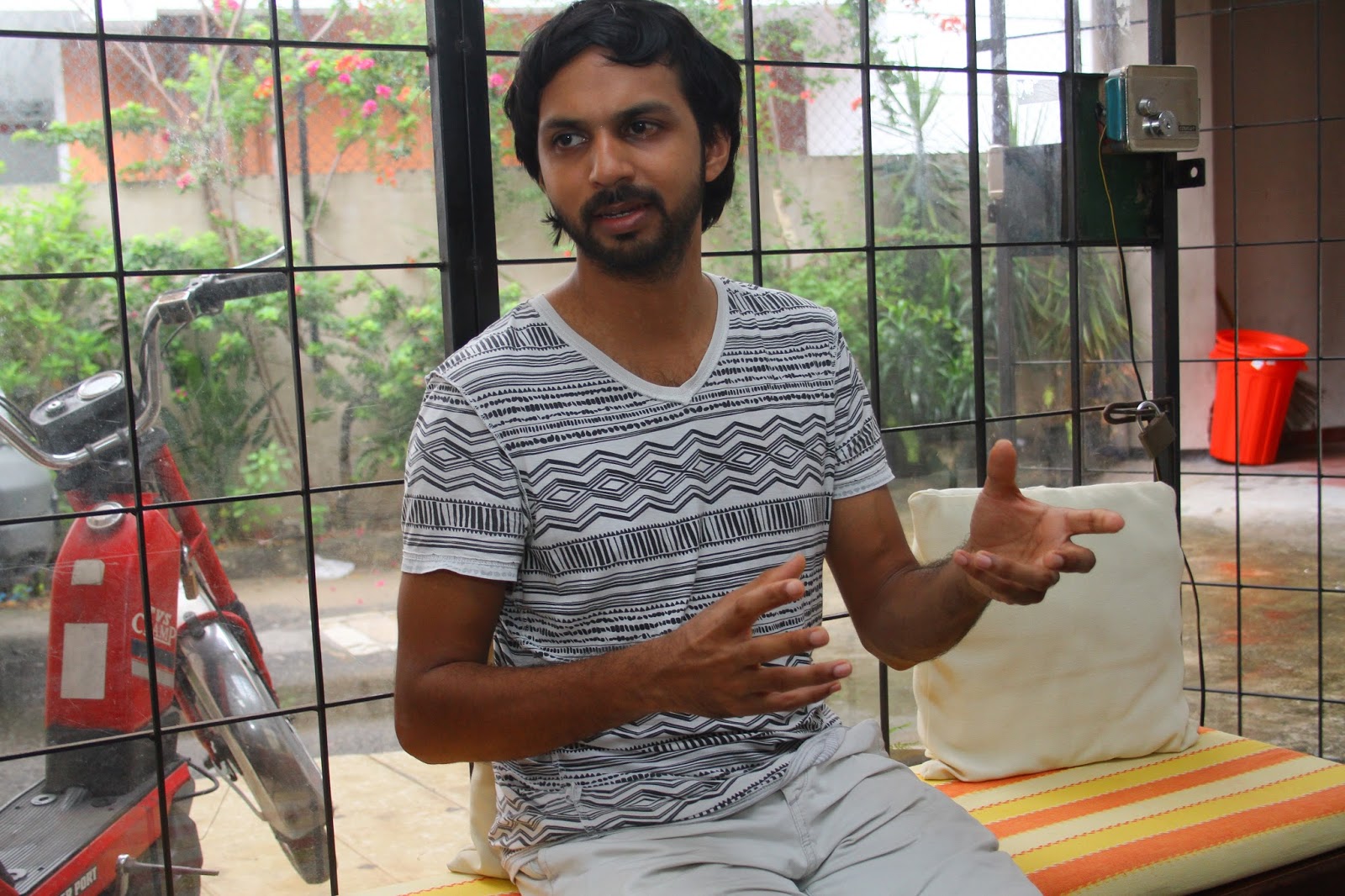
Dr. Suraweera Pic by Ravindra Dharmathilake

“I’m not sure how practical it is to watch these rituals and the rich music components which come along with it being forgotten. Our attempts are not to reenact these rituals, but to attempt to save the components we can save.  This is not to degrade the values of these rituals,” he said. “If the rituals die, music in it will die with it,” he emphasized.   

Fusion between Sri Lankan traditional music and Western Jazz music, as Sumudi said, is the way he is trying to find his identity. Young Sumudi moved to New Zealand with his parents when he was 13 years old. While he was in Sri Lanka he was a student of Colombo D.S Senanayake College.  Even though they moved to a foreign country, Sumudi said that his family always embraced the Sri Lankan culture. As a child he always adored music, and this was the reason behind why he chose music as his field of study following his strong passion towards music in high school and university.
He said that he adored jazz music and recognized that he expressed himself at best with jazz drumming. Suraweera obtained his PhD in the discipline of ethnomusicology in 2010 from the University of Canterbury, New Zealand focusing his research on Sri Lankan Low-Country traditional drumming.

Speaking about the research he carried out he paid his respects to his main consultant for the research, late Sandoris Jayantha Gurunnanse. He also remembered maestro Piyasara Shilpadhipathi who supported him throughout his research work. As he said, limited resources were one of the main challenges he faced in collecting information. ‘It was not a simple process,’ he said pointing out that this is also a reason why these rituals should be preserved without waiting.  

Båliphonics was also initiated with Sumudi’s research studies.  As a Sri Lankan who grew up in New Zealand, he believes that he has adapted to the diversities of both cultures. Although he grew up among New Zealanders, his passion for his mother country didn’t die. He reiterated that what he does now, is a reflection of his identity nurtured by two countries. Båliphonics group itself is a representation of this fusion. Two brothers, Susantha and Prashantha Rupathilake voice traditional chanting for the music provided by Isaac Smith and Dr. Sumudi Suraweera with double bass and the drum kit respectively.

Sumudi fondly remembered Eshantha Pieris, cofounder of Musicmatters who is currently abroad studying for his doctorate, who used to play the piano for Båliphonics. Smith, who has volunteered at Musicmatters as an instructor since 2010, is Sumudi’s colleague from New Zealand. He said that, Smith too is now well adapted to the Sri Lankan culture that he is quite absorbed in it.

Båliphonics has also performed outside Sri Lankan context at several occasions. They have toured in Malaysia and Singapore with this novel form of Sri Lankan traditional music and Sumudi is content about the feedback they’ve received. “Båliphonics were very well received and they were mesmerized by our performances,” he said adding that our traditional performances are sometimes seen magical in the foreign context.

Båliphonics, recently performed at the Jaffna Music Festival, succeeded in mesmerizing those gathered at the Jaffna Municipal Grounds too. Although the performance at the Jaffna Music Fest was time bound, he said that a usual performance of Baliphonics takes more than one hour and that it has a nice flow that encapsulates the audience.

Musicmatters’ main responsibility is the music institution located in Borella, where they conduct music programs for children to enhance their individuality and ensemble performances with a touch of theoretical knowledge. Since its inception, Musicmatters has earned a reputation for its enjoyable and practical approach to music providing its students with the opportunity to be creative and innovative. In contrast with the local music curriculum, Sumudi mentioned that students of Musicmatters are assessed for their creativity more than their theoretical knowledge.

“Our method goes beyond the traditional exam-oriented education system,” he explained while explaining how their students are assessed by their performance at the end. Speaking further about the music curriculums in the country, he criticized the local music curriculum for lack the spontaneity and creativity. As he said, “Music offers a lot more than other forms of entertainment and is transferrable to other components of education”. This is why building creativity and spontaneity in children is important.

Other than the music institute and the Baliphonics, Sumudi considers organizing the annual Musicmatters music festival as an important duty of the collective.  This year Musicmatters festival will be held in August for the fourth consecutive time.  Sumudi explaining the goal behind organizing this festival said that it’s done with the aim of promoting Sri Lankan music in the western world as well as to expose the Sri Lankan audience to music that is generally not accessible through mainstream media.  Various artistes from Germany, Australia, Singapore and United States of America will be among the usual participants.

“Our hope is to give Sri Lankans some kind of inspiration through this to be open to what they weren’t open before. And ultimately open up their minds in whatever the field of work they are engaged in, to challenge their accepted notions and to strengthen their thinking,” Sumudi iterated that experiencing various forms of music can inspire an individual to think outside the box.

Singing in praise of God

Pic by Sakuna M Gamage


Sinhala ithihasa pothe ran akurin liyawuna, Lassana podi punchi puthek lak manita nathiwuna…” He was a Muslim singing in Sinhala. He was from the Eastern part of the country came to sing in the north. Bawa Nasrudeen Kaleefa was one of the performers who grabbed attention at the Jaffna Music Festival. Nasrudeen came all the way from Akkaraipattu to perform at the Jaffna Music Festival. He led a group of eight singers, all Sufi musicians, which represented Islamic Social Heritage Association. 

“Performing at the festival makes me happy. It makes us all happy,” he said in an interview with The Nation at the Jaffna Municipal Grounds. He doesn’t speak Sinhala although he sings fluently in Sinhala. With the support of the coordinator of the Muslim Sufi Group Muszhaaralff in translating his words to English, he said, that performing their music at any event or time gives him immense pleasure.

Nasrudeen had started his journey in music when he was barely 20 years old. Today, he speaks about his 40-year-experience as a Sufi musician with pride. He didn’t attend any music school, but learned the basics about music and singing from his spiritual teacher and practiced what he learned until he became perfect. The purpose of his singing, he said, is to show his passionate love towards God.

According to Nasrudeen, Sufism is not a division of Muslim, rather it is considered a part of Islamic teaching that deals with the purification of inner self.  They believe that focusing on the more spiritual aspects of religion as striving to obtain direct experience of God.
Sufi music is the devotional music of the Sufis, inspired by the works of Sufi poets, like RumiHafizBulleh Shah, Amir Khusrow and Khwaja Ghulam Farid. Sufi communities or orders are found throughout the Muslim world, from South and Central Asia through Turkey, Iran, Kashmir, India, the Levant and northern, eastern and western Africa and also England. Sufi love songs are often performed as Ghazals and Kafi, a solo genre accompanied by percussion and harmonium, using a repertoire of songs by Sufi poets.
With the wide geographical and cultural spread of Sufism itself, Sufi musical practice is itself equally diverse. As Nasrudeen explained, each Sufi order or brotherhood has its own traditions, and forms of Sufi practice which varies greatly from region to region. However he further said that all these different facets of ritual and performance have the same goal in mind. “We use music to remember God and to move closer to the divine,” he said.  
He further defined Sufism as purely based upon the beliefs of Islam and the teachings of Muhammad although ‘ordinary believers’ of God have obligations towards Sufism and their aesthetic performances. He expressed his grief on how some sects of Muslims are reluctant to accept Sufi music.  Some Muslims prohibits any form of music that is not entirely devotional to Allah. A general perception is that Islam bans all music, but Nasrudeen said that this is not true. Islam only prohibits non-devotional music and when it is associated with other sins such as drinking alcohol, which is entirely prohibited. “Music reflects Allah. It creates a path for me to address him,” he said.  

Muslims believe that they will see God in the afterlife. The Sufis devote their lives to seeing God now, in this life, and becoming closer to the divine by following Islamic law. As he mentioned before, Muslims do not always agree with this aspect, but Sufism certainly does provide a spiritual, supreme root for the popular practice of Islam, as it is with most other religions.

Commenting on the music festival, Nasrudeen emphasized that setting effort to introduce different cultures to everyone and make them familiar to each culture in the country is a great way to rebuild harmony. “We lost many things during the thirty years of war. This is essential to bring everyone closer again. Each of our cultures has good things to share, good things we couldn’t share for a long time,” he iterated. “Especially music has components which can bring back harmony,” he said adding that music is understood by everyone although one language is not understood by everyone, taking himself as an example. He said that he enjoys listening to Sinhala songs and singing them although he can’t communicate in Sinhala.

He also expressed his sadness about the disputes between certain Sinhala communities and Muslim communities. He said that nobody who admires the spiritual aspects of a religion would fight each other. “None of the religions teach people to fight each other for materialistic themes. Religions teach people how to love and accept each other,” he stressed. “I believe the problems start when people try to focus more on the rituals rather than the spirituality,” Nasrudeen opined.

“As a Sufi, I have been taught to see everyone as God, every place as God and everything I associate as God.  So, I don’t understand the reasons why we are quarreling with each other. Why fight with our own God?” he raised a question.

Monday, June 22, 2015

Was Buddha the first psychologist?

Psychology is the science of the mind. The psychologists say that human mind is the source of all thought and behavior. When we think about psychology, the first person recalled is usually Sigmund Freud or some other prominent Western psychologist who explained human behavior using a theory they believed. True enough, being the father of psychoanalysis Sigmund Freud’s work, or being the father of modern psychology Wilhelm Wundt’s work were largely responsible for the development of modern day psychology.  Yet, were they really the first people to talk psychology?

In psychology, the psyche is the totality of the human mind, conscious and unconscious (Wikipedia). Freud discussed this model in the 1920 essay ‘Beyond the Pleasure Principle’ and this can be considered as the earliest examples where the concept of mind was spoken in a western context.  Although we cannot observe the mind directly, everything we do, think, feel and say is determined by the functioning of the mind. It was not the modern day psychologists who first identified ‘the mind’. Almost two millennia before Freud spoke about psyche, the Buddha spoke of the human mind, identifying that all human behavior is under the responsibility of the mind.

Manopubbangama dhamma 
manosettha manomaya
manasa ce padutthena
bhasati va karoti va
tato nam dukkhamanveti
cakkamva vahato padam.

All mental phenomena have mind as their forerunner; they have mind as their chief; they are mind-made. If one speaks or acts with an evil mind, dukkha follows him just as the wheel follows the hoof print of the ox that draws the cart (Dhammapada )
Buddha explained that the mind is the most dominant, and it is the cause of the other three mental phenomena, namely, Feeling (vedana), Perception (sanna) and Mental Formations or Mental Concomitants (sankhara).

Buddhism more closely resembles Western psychotherapy than any Western concept of religion. Jon M Cefus writing to the Joseph Campbell Foundation blog in 2009, spots how Buddhism provides tools helping to alleviate psychological suffering.  “These are called the Four Noble Truths.  The truths taught by Siddhartha Gautama offer a view of reality that is based on natural law,” he explains. 

Buddha was commonly referred to as ‘the great physician’ and like any therapist, made it his aim to identify, explain and end human suffering. All therapists do have similar aims. Four Noble Truths (Chathurarya Sathya) are the method to adopt a diagnostic format to explain suffering and its cure.  The Four Noble Truths are the truth of suffering, the truth of the cause of suffering, the truth of the end of suffering, and the truth of the path that leads to the end of suffering. In a therapeutic setting; the first Noble Truth identifies the disease, the second provides etiology, the third gives a prognosis and the forth suggests a remedy.

How Buddha helped Kisagothami is one of the many examples where Buddha can be seen as a modern day psychologist. Kisagothami was desperate after losing her children and family that she went from house to house clasping her dead child to her breast, asking for medicine to revive the dead son. Buddha welcomed her with Unconditional Positive Regard (a concept developed by the humanistic psychologist, Carl Rogers, is the basic acceptance and support of a person regardless of what the person says or does), identified her irrational beliefs and helped her dispute them on her own, asking her to bring a handful of mustard seeds from a house where no one has died.

This is just one example found in Buddhist Jataka Stories which show similarities to Albert Ellis’s ABC model in Cognitive Therapy. The ABC Model refers to three components of experience in which a person can ascertain if his or her belief system is distorted. The well-known stories of Aalawaka, Angulimala as well the episode of queen Khema who had irrational beliefs about her beauty are few other examples of how Buddha helped people to eliminate their irrational beliefs.
A main view of Behavioral psychologists is that Behaviorists view humans as being born neither good nor bad by nature, but rather as being neutral by nature. But wasn’t Buddha the first one to point this out too?

Najaja wasalo hothi
Najajja hothi Brahmano
Kamano wasalo  hothi
kammano hothi brahmano

You do not become a Brahman (Nobel) with your birth nor does birth make you a low cast. It’s your own deeds that decide which. (Dhammapada)

Existential psychology is another major branch in psychology which speaks of ontological anxiety (dread, angst). Its therapy operates on the belief that inner conflict within a person is due to that individual’s confrontation with the givens of existence.  “Buddha said that life is suffering. Buddha said that suffering is due to attachment. Existential psychology also has some similar concepts. We cling to things in the hope that they will provide us with a certain benefit. Buddha said that suffering can be extinguished. The Buddhist concept of nirvana is quite similar to the existentialists’ freedom. Freedom has, in fact, been used in Buddhism in the context of freedom from rebirth or freedom from the effects of karma. For the existentialist, freedom is a fact of our being, one which we often ignore. Finally, Buddha says that there is a way to extinguish suffering. For the existential psychologist, the therapist must take an assertive role in helping the client become aware of the reality of his or her suffering and its roots. Likewise, the client must take an assertive role in working towards improvement–even though it means facing the fears they’ve been working so hard to avoid, and especially facing the fear that they will ‘lose’ themselves in the processes. (Boeree CG. Towards a Buddhist Psychotherapy, 1997 )

Our very own psychiatrist D VJ Harishchandra in his book titled, ‘Buddhism and Psychiatry’ identified common psychological theories in Western psychology explained in Buddhism. In his book he discusses Viyo Duka (bereavement), Balaporottu Kadaweema hevath Ichchabangathwaya (Frustration), Buddunwahanse Mano Chikithsakawarayaku Lesa (Lord Buddha as a psychiatrist of eminence), Maranaya Saha Viyoduka (death and grief counselling) Bheethika (Phobias), Danathmaka Mano Vidyawa (Positive psychology), Pasuthevilla (Regret) Grantha Chikithsawa (Bibiliotheraphy), Sihina Vigrahaya (Analysis of dreams) and Mano Ranga Chikithsawa (group psychotherapy).

In psychology, American Psychologists Association’s Ethical Principles of Psychologists and Code of Conduct lay out standards for psychologists and identify behaviors that deserve punishment. Interestingly, long before ‘psychologists’ existed and psychology was named ‘psychology’, Buddha helped people who came seeking his help in an ethical manner. British Indologist CF Rhys Davids translated Abhidhamma Pitaka from Pali and Sanskrit texts in 1900. She published the book entitled, ‘Buddhist Manual of Psychological Ethics’. In 1914, she wrote another book ‘Buddhist psychology: An inquiry into the analysis and theory of mind’ (Journal article Buddha philosophy and western psychology by Tapas Kumar Aich).  Rhys Davids in her book ‘Buddhist Manual of Psychological Ethics’ wrote, “Buddhist philosophy is ethical first and last. Buddhism set itself to analyze and classify mental processes with remarkable insight and sagacity”.

What can be mentioned in this article is limited. Yet connections between modern day psychology and Buddhism are unlimited. These Buddhist traditions have been built and refined for almost 2,500 years, and are older than any of the modern day theories in psychological practice and still valid in contemporary practice.

 In summary, as any of the psychological theories, Buddha’s teachings attempt to define why we suffer and offer ways in which to ease this suffering.  Stress, depression, anxiety are few among the common psychological problems. Compared with a few decades ago, the numbers of complaints are on the rise today, even in the Buddhist society.  Are these issues on the rise because we are losing the grip on the essence of Buddhism;  because we go behind worshiping statues more, rather than trying to understand the depth of dharma? However, isn’t it heartbreaking how people suffer from psychological issues so much, when we were being told the correct path to take to ease our pain, millennia ago? 
- See more at: http://www.nation.lk/edition/insight/item/40360-was-buddha-the-first-psychologist?.html#sthash.BgWP7iGS.dpuf

Saturday, March 28, 2015

Voice behind ‘Dosthara Honda Hitha’

Interview with artiste Parakrama Perera


Not many will recognize Parakrama Perera by his name. Not many will recognize him from his picture on this page. Yet, for someone who has watched early Rupavahini cartoons dubbed in Sinhala, his voice will not be unfamiliar. ‘Puru puru, Maalu katta dan api wada pataaan gannayi yanne’ , ‘Bibili nagina belikatu...’ – these phrases, with their unique voices, are forever etched in our minds. It was Parakrama Perera who voiced these characters. He was the Poos Lokka in Pissu Poosa, Doctor as well as Chaw-Chaw in Dosthara Honda Hitha and Captain Hadock in Tintinge Weera Kriya. This would suffice as introduction, but these are just a few characters he voiced, loved by thousands.
Born and raised in Suduwella, Colombo 10, Parakrama started his journey as a child artiste in Children’s programs of Lama Ranga Pitaya at Radio Ceylon, since one of his relatives took him there, to make his childhood dream come true. As a child Parakrama loved listening to radio and wished one day he could visit Radio Ceylon to observe how the voice he listens to through radio comes to his house. Later he received the opportunity to work as a dubbing artiste under veteran Titus Totawatte. As a young artiste he was able to gain recognition for his talents through Madol Doova Radio Drama, playing the role of Jinna. Kuhubuwo, Nandi Wishala, Handiye Gedara and Landesi Dupatha were among the popular radio dramas he contributed to, early in his career.

“I enjoyed playing the roles of Handiye Gedara Nawarathnam and Vandabona in Jiljona and Vandabona very much. Both stories were loved by their listeners and those characters were highly appreciated,” he recalled. “Taking part in radio programs during this period was like attending a university. Veterans like Karunarathna Abeysekara, Chithrananda Abeysekara, Prabha Ranathunga, Nanda Jayamanne, Siril Rajapaksha, Madawala S Ratnayake, Sugathapala de Silva and Dayananda Gunawardana were our gurus. They guided us so well that we were able to build our careers.”

He first met Martin Wickramasinghe following an invitation to visit him at his home as an appreciation for a job well done in voicing Upali and Jinna in Madol Doova radio drama. Rohana Siriwardana, whom Parakrama mentions as his ‘mango’ friend in the field, played the role of Upali.
His late colleague Premakeerthi de Alwis was a sensitive topic for Parakrama. “He called me Para,” he recalled. “Although I was not as competent as he was in presenting programs, he chose me as his partner in the second studio for some of his programs. It brings me to tears when I recall how good this man was to me.”

Taking about Prem actually brought Parakrama to tears. “His mother and mine were good friends and I remember an incident where we all went on a trip to Kataragama,” he recalled an incident when he accidently erased a news making picture Premakeerthi took.
During this period Premakeerthi was a journalist for the Visithura Newspaper. He captured a picture of a janitor who was on his ways to clean a toilet with a bucket of water. He does an incomplete job. Knowing this, another follows him with another bucket of water. Prem noticed this and was able to capture this after waiting for a long time. “He asked me to hold on to the camera and went away. I didn’t know how to operate the camera but I wanted to try to take a picture of our mothers cooking for us. Unfortunately, I have pressed the button while the same film was on, and Prem’s news picture was destroyed. I thought this would ruin our trip. But he was a sensitive man, he understood my immature need,” he said.

It was on Premakeerthi’s suggestion that Totawatte invited Parakrama for Rupahavini dubbing. Apart from Pissu Poosa and Dosthara Honda Hitha, he voiced Captain Hadock in Tintin, and other notable characters in Gulliverge Suvisariya, Situwara Montha Kristho, Nothradamaye Kuda, Malgudi Dawasa, Oshin and Senehase Ayithiya. He also mentioned his colleagues Saman Athawudahetti, Karunathilaka Handuwala and Rohana Siriwardena, Geetha Kanthi Jayakodi and Neranjala Sarojini with much affection.

He also spoke highly about Athula Ransirilal, who follows in the footsteps of Titus Totawatte. “His commitment to the field is extraordinary. It’s a blessing to have such people or else the quality of dubbing as well as the field itself would collapse,” he said. He went on about how the hard work of Ransirilal had enriched the locally produced cartoons. He specifically mentioned the recent cartoon programs Kumara Gee, Sunil Gee as well as Tomiya saha Kitiya, Andarege Katha and Pancha Thantraya. “These cartoons are created and produced locally. Therefore, I believe that these are better for our children as it brings out Sri Lankan essence,” he iterated. “It’s nice to see Sri Lankan productions on television. We have been watching foreign cartoons for a long time,” he added.
He also spoke about the new dubbed Asian television dramas telecasted in Rupavahini. “All these are carefully selected dramas with great story value. It is no surprise that people love these,” he said adding that they are now working on another new drama named Siri meti Siththarawi which is woven around a Korean legend who lived in the 16th Century.

Although he was a voice artiste, his fulltime career was at Colombo Municipal Council. He retired from his job as a supervisor recently after a service of 42 years. A felicitation ceremony was held two years ago, to appreciate his service to the CMC as well as a dubbing artiste. He currently works as a consultant to the voice training institute, ‘Voice of Sri Lanka’. “Voice training is essential for an artiste. But for a person who doesn’t have an inborn talent this will be a difficult task,” he said. He also said that the demand for skilled voice artistes are now less compared to the era in which the field was established. “New technology allows unskilled people to come off as skilled,” he said, expressing his grief over the lack of demand.

He pointed out that the recognition a voice artiste receives is less compared to the recognition received by actors. “People don’t recognize us when they see us, they barely remember our names. Satisfaction comes with the love they express for the characters we voice,” he said. If the voice artiste has not done an exceptional job, the audience would not fall in love with the characters they voice.

Pics by Ravindra Dharmathilake

Friday, March 27, 2015

An actor’s philosophy which revolves around image

Renowned artiste Dharmapriya Dias talks us through his acting career which is dotted with many accolades, including the award for the Best Actor for his role in Hyena at the State Drama Award in 2003


Award winning actor Dharmapriya Dias believes that a fine comedy play is not merely an act which makes people laugh at low grade jokes and impersonation of famous personalities or speaking dirty.
“I don’t understand why people should laugh at mistakes made when speaking a foreign language or insults made on another human being. Saadaya Marai - Salli Hamarai doesn’t fall under this category. This is an attempt to create meaningful humor without using profanity or laughing at the expense of one’s culture,” Dias told The Nation while speaking about his latest stage play direction Saadaya Marai Salli Hamarai adapted from the farce Funny Money written by the British Playwright Ray Cooney.
Dharmapriya is known in the field for his commitment for acting. According to him he has been committed to acting from school days at Piliyandala Madya Maha Vidyala. “I was curious about acting since I was very young. I always wondered how children got to play different roles in Vesak Dramas played near Kesbewa Wewa. I wanted to know why I couldn’t play a role,” he recalled how he enjoyed theater as a child.
Young Dharmapriya was confused why the king from the Vesak play rode a bicycle to work. “The person who wore jewelry and shimmering costumes on Vesak day, went to work wearing office attire. This puzzled me,” he said that it was under his school drama master Premkumar Karunarathne that he learnt the ABC in drama. Their work including Muthu Etaye Geethaya which won many accolades in school drama competitions. 
Dharmapriya’s firsts contribution to popular theater was in Bandula Vithanage’s Romaya Gini Gani. “Working with this drama crew was like a practical workshop for me. I learnt much about popular theater,” he reminisced. With this debut drama, he received the opportunity to work with veteran dramatists the likes of KB Herath, Jayalath Manoratne, Rajitha Dissanayaka, Neil Alas, Pujitha de Mel, Sarath Kothalawala, Chamika Hathlawaththa and Thumindu Dodamtenna.
He specifically mentioned the roles he played in S Karunaratne's Hyena, Rajitha Dissanayake’s Apasu Harenna Be, Mata Wedi Thiyanne Nadda, Thumindu Dodamtenna’s Arundathi and Thilak Nandana Hettiarachchi’s Guti Kamata Niyamithayi as the roles he mostly enjoyed playing. His critically acclaimed role in Athula Pathirana’s Dolahak is also noteworthy. 
Dharmapriya has won many awards including Best Actor - State Drama Award for his performance in Hyena directed by Chamika Hathlawaththa in 2003, Best Set Designer for Ruwan Malik Peiries’ Dasa Mallige Bangalawa (Dasa Malli’s Bungalow) in 2004, Best Choreography in his production Gehenu Lamai Weda Arambathi and Youth Drama Festival’s Assistant Actor for Lanka Ishan Kankanamge’s Sanda Sewanella in 1997. Saadaya Marai Salli Hamarai is his second stage direction while Gehenu Lamai Weda Arambathi marked his debut.
His talent for acting is not limited to the stage. He said that he still enjoys his work as a radio and television voice artiste. He began working with radio and television during the early stages of his career. He considers the opportunities he received while working with teledrama directors Nalan Mendis, Sudath Rohana and DG Somapala as blessings. “Experiences gained on stage helped me immensely in adapting to teledramas and cinema,” he explained. “Having to act in Wimalarathna Adhikari’s Ingammaruwa was an extraordinary experience in the teledrama field,” he said remembering how teledramas employed radical themes, couple of years ago
Dharmapriya was regarded as the Best Actor for his first lead in the internationally acclaimed movie Machang by Oscar nominated producer Ubarto Passilini. Dharmapriya played minor roles in Vijitha Gunaratne’s Wala Patala and two other films Bora Diya Pokuna and Nahi Werena Werani, which have been awaiting release for past several years. He mentioned that Machang was a turning point in his personal life as well as his acting career. “I used to be double the body size I am now, I had no control over eating. I didn’t give body image much importance,” he recalled how he almost missed the role in Machang. “They told me that although I am suitable for the role, they can’t give it to me since my body image doesn’t match the character. They challenged me to lose weight that if I did they would give me the role.” Not only did Dharmapriya accept the challenge and succeeded, he wound up creating one of the most celebrated roles in the recent film history. Playing his maiden major role in this internationally acclaimed movie, Dharmapriya received the opportunity to travel to many countries. He also pointed out that physical and mental well-being is essential to becoming a successful actor. “This is rare in the Sri Lankan setting,” he said.
He further said that the experiences he acquired travelling across the world made him question the situation of contemporary Sri Lankan cinema. “I observed that in many other countries acting is a respected as well as a well paid profession,” he pointed out that most Sri Lankan actors are engaged in the field part-time as artistes while doing a fulltime job in a completely different field. “I’ve heard that there was a time in Sri Lanka when such value was attached to the profession. Too bad I never got a chance to witness it,” he lamented.

Speaking further about theater productions, Dharmapriya said that there has always been a stable audience for stage plays unlike cinema and teledrama. “Audience for stage plays has been considerably stable during both good and bad times. People came to watch plays even during the period of the armed conflict. There were fluctuations, but the dramatists were able to maintain the quality of the plays.” He said that the dramatists have attempted to give the maximum to the field using the limited resources they have. “Unfortunately, facilities in theaters have deteriorated. None of the responsible parties have looked into this.  This is a very sad situation,” he emphasized.

Thursday, March 26, 2015

Walking on the shadows of Hattottuwagama

Deepani Silva, who is committed to promoting street dramas, talks about the interesting times, experiences and lessons learnt while working with a legendary father figure in the field of acting  

(Pics by Ravindra Dharmathilake)

Award winning actress Deepani Silva celebrates four decades in her acting career in March 2015.

The late Gamini Hattottuwagama, through street dramas in Sri Lanka, offered citizens an amazing theatrical experience.  This roadside experience was offered free to the public. Yet, several decades later, there was a period where street dramas were not shown. Deepani Silva, one of the first stage drama students of Hattottuwagama, with the support of several other former members of Hattottuwagama’s drama team established Gamini Hattottuwagama Foundation to develop this theatrical component, identifying this downfall.
Deepani said that her voyage in the drama field began unexpectedly as she joined Ranga Shilpa Shalika looking for a way to spend time after her final school examinations in 1975 with her cousin sisters. Ranga Shilpa Shalika was the first institute to introduce a program to teach drama and theater studies.  Late veteran Gamini Hattottuwagama was one of the instructors at the institution and he was trying to build up a street drama group by the time Deepani joined the class.
 “I didn’t know anything about street drama. Yet Hattottuwagama Sir invited me to join in with them as he observed that I have acting skills which can be useful in street drama,” she recalled.  She said that she didn’t have an expectation to become an actress, but was curious to learn how things happened behind the curtains. She said that she developed an interest because of the stage dramas she watched during her school days at Kalutara Balika Vidyalaya and Colombo Buddhist Ladies’ College.
After joining Hattottuwagama’s street drama team she received the opportunity to take part in two special role-plays produced by Hattottuwagama and H. Karunarathna for Christmas. “I was a part of these two dramas, Akeekaru Puthraya and Jesu Jerusalamata Pamineema. Therefore my acting career started on an altar,” she reminisced. She also recalled how she traveled across the country with this drama group. “I was amazed by this new experience and was surprised how the team was enthusiastic about the performances although it didn’t benefit them financially. Luckily I received the blessings from my family,” she said recalling how the family shared her interest and encouraged her to follow her heart once they got to know how exciting street drama was. 
Deepani’s father, J Peter Silva was a teacher as well as trade union leader in Kalutara, Katukurunda.  She grew up in an environment where they openly discussed political and social issues. “I believe that was the reason why I wasn’t too scared to engage in street drama. I was familiar with the subjects due to the experiences I received at home mingling with the society,” she said.  She also said that politics and art always went hand in hand and even though an artiste doesn’t get on to a political stage she or he will always be speaking politics. “To engage in party politics or not is a personal choice. It depends on the person. However, the artiste should always take the general public’s side, always speaking against the unjust happening to them, if there is any,” she stressed.
After Hattottuwagama passed away, the need for a leadership reemerged in the street drama field.  “We identified this need and a few from the first group got together again to create a program for the younger generation. She also mentioned how Hattottuwagama Sir taught them the techniques in a practical manner while engaged in a drama. As a tribute to him they established the Gamini Hattottuwagama Foundation to support the Sri Lankan Street Drama.  
 “Street drama is open to anyone in the society. Performances will be on the road, so anyone-from a person who drives a luxurious car to a beggar on the road- can come and see,” she explained. Street theatre as she said goes to its audience rather than the other way round. Its different performances depend on time and place; it can range from public theatre through a town or village to a demonstration at a factory or an organization, linked up with a social or political campaign. 
She iterated that a street drama artiste should be highly skilled. “Everyone at the audience should hear what he or she is saying despite the disturbances in the environment. Performance should be directed to everyone around the circle.  None of the spectators should be missed,” she said.  “It’s a difficult task as the spectator can see every step from getting ready- wearing costumes to the performance,” she added. She further said that the street dramatist should also be knowledgeable about the current situation of the society apart from the street drama and acting skills that they have to engage with the spectators and should be ready accept or respond to the feedback.
She said that economical benefits are secondary in street dramas and that the group is more focused on sending out a message. “Most of the time, a street drama is organized from personnel funds of the dramatist.  If the organizers are ready to pay for our transport, that will be welcomed and appreciated. Even if not, we won’t fuss,” she said.  She also said that whatever money they raise through the hat collection at the end of the performance satisfies them. They use the money for their accommodation and improvements of their costumes and decorations.  “A hat collection is a tradition carried out in street drama, not that we receive a lot of money through this,” she reflected.
 She argued that street drama has the potential to convey political messages to the society stronger than other form of art. “That should also be the responsibility of the artiste engaged in street drama. Problems and issues concerning the society can be easily convinced to the society through this. Since the drama goes to the people on the road, the messengers don’t have to wait until the audience comes to them to convey the message,” she added.
Deepani also joined stage drama, television and the silver screen later in her career. She has contributed in over 25 stage dramas including Weddikkarayo. She first joined the Television through Shrimathi Liyanage’s Children’s drama. Her debut episodic drama was Lucian Bulathsinhala’s Thara Devi. The dumb woman’s character she played in Thara Devi was much loved an appreciated. This role made her a star in the teledrama field. She said that she feels proud that she has been able to maintain her popularity continuously until today. “I have never played the lead role of a teledrama, yet most of the characters I played were loved by the teledrama fans,” she said.
She entered the silver screen with the role in Hewawasam’s Meeharaka in 1980s. She got nominated for the Best Actress Award for the character she played in Anura Chndrandrasiri’s  Thunweni Aha.
Today she mostly contributes to teledramas apart from her involvement in Street theater. She also spoke about the teledrama industry in the country. She lamented that the teledrama industry has become a factory which caters to the demand of the buyers. “Producers are more interested in finishing more episodes in a day rather than producing a drama high in aesthetic qualities,” she lamented.
She identified few disadvantages an artiste faces today. “In Sri Lanka acting is not a recognized profession. You can’t apply for a bank loan being an artiste. You won’t receive a pension when you are old. Most of all, acting is not a secure job. You’ll get roles until you have the demand.  If you lose it you lose your financial stability,” she pointed out.
She also emphasized the need for a valid institute to teach drama and theater studies. “There should be a place where students can observe skills of veterans and learn and a place where they get a valid recognition,” she said. “Acting is no easy job if done properly. It requires training and constant practice as well as confidence. This is why people who started the career as stage dramatists tend to remain in the field for a longer time than others who are not,” she said.


Thursday, February 19, 2015

Miranda Hemalatha still in the tempest


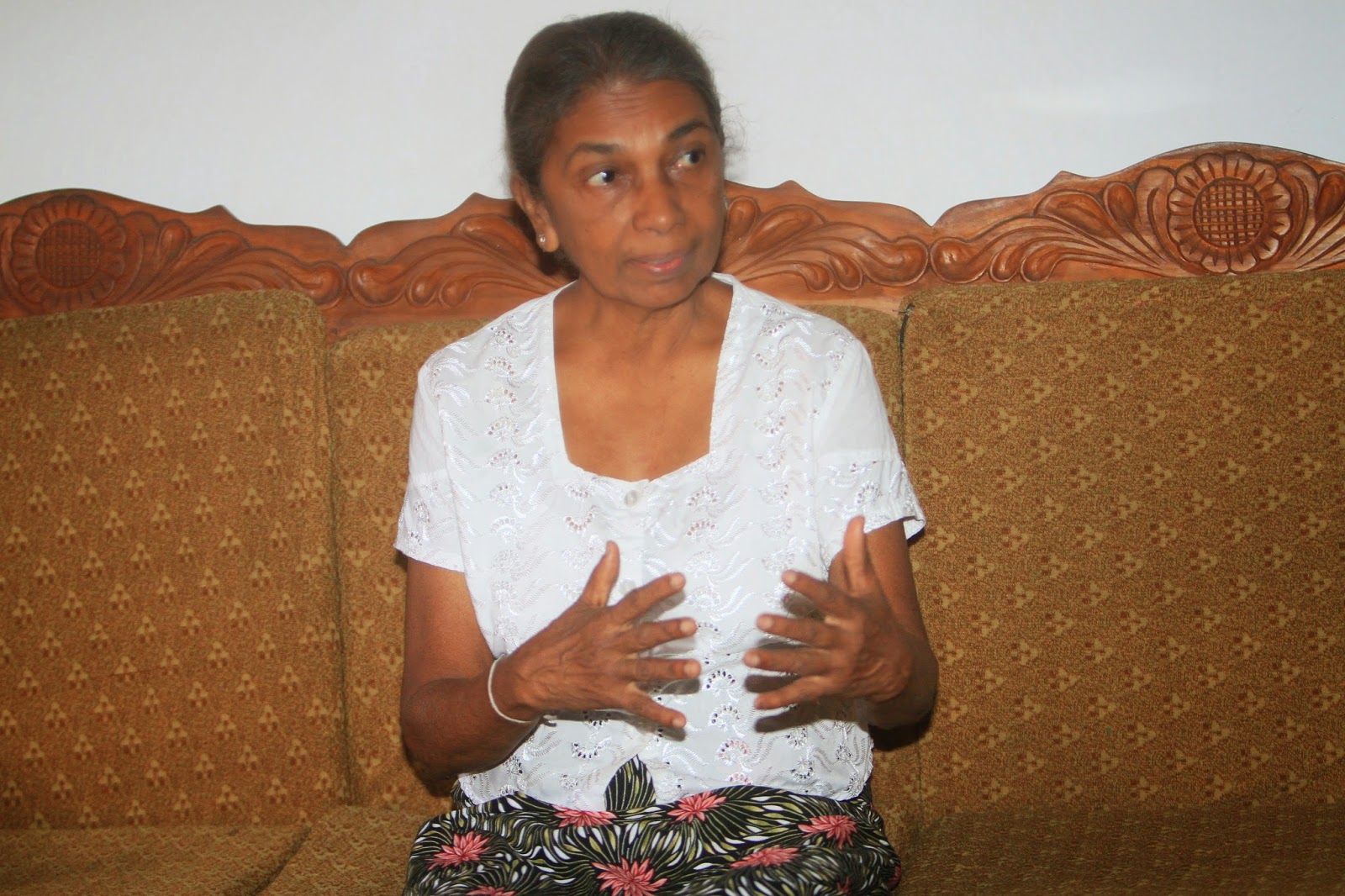
“A psych evaluation must be made mandatory in recruiting new teachers,” said educationist Miranda Hemalatha who is also an award winning dancer, actress, choreographer as well as a director of drama, in an interview with The Nation. “I recently read that about 70 percent of school children have some type of a mental disorder. If this is true, it is a segment of these students who get through to universities. A person who walks out as a teacher from a university might be a person from this group,” she noted, adding that this might result in more serious issues if overlooked now. “There isn’t a method to evaluate the mental state of people who receive appointments as teachers,” she said, reiterating the need for a psychological evaluation for teachers with the recent unfortunate incidents of corporal punishments and sexual abuse in the school environment.
Best known for her ballets productions, Miranda has been producing dance programs, with many new production, since 1957. Ranga Dahara, Nupura Rawaya, Nritya Prasadini, Narthana Rekha, Nrithya Pushpanjalee, Ranga Leela and Narthana Pooja are a few among them. She also contributed in dramas Kadawalalu, Rathnawalie, Mati Karaththaya, Janelaya and Liyathambara as an actress.
She is known for the experimental dance dramas she produced. Vasantha Thilaka, Thanha Asha, She, Deewari Geethayam Swarna Thilaka are among the most appreciated dance dramas. She said that she has always tried to depict the destruction taking place in society through her dramas, again trying to be a rebel on stage.
Starting her professional life as a teacher in Vanathamulla Central College, Miranda gradually made her way to becoming the first Directress of Aesthetic Education in Sri Lanka. She worked for the Education Ministry for 37 years, for the Teacher Education Department for 16 years. She was in administrative service for 15 years. Today, she is the Chairperson of Diri Daru Piyasa at Kindelpitiya; an institute for the Down Syndrome children who seek assistance to enter society as independent individuals; and Miranda Hemalatha Kala Ashramaya.
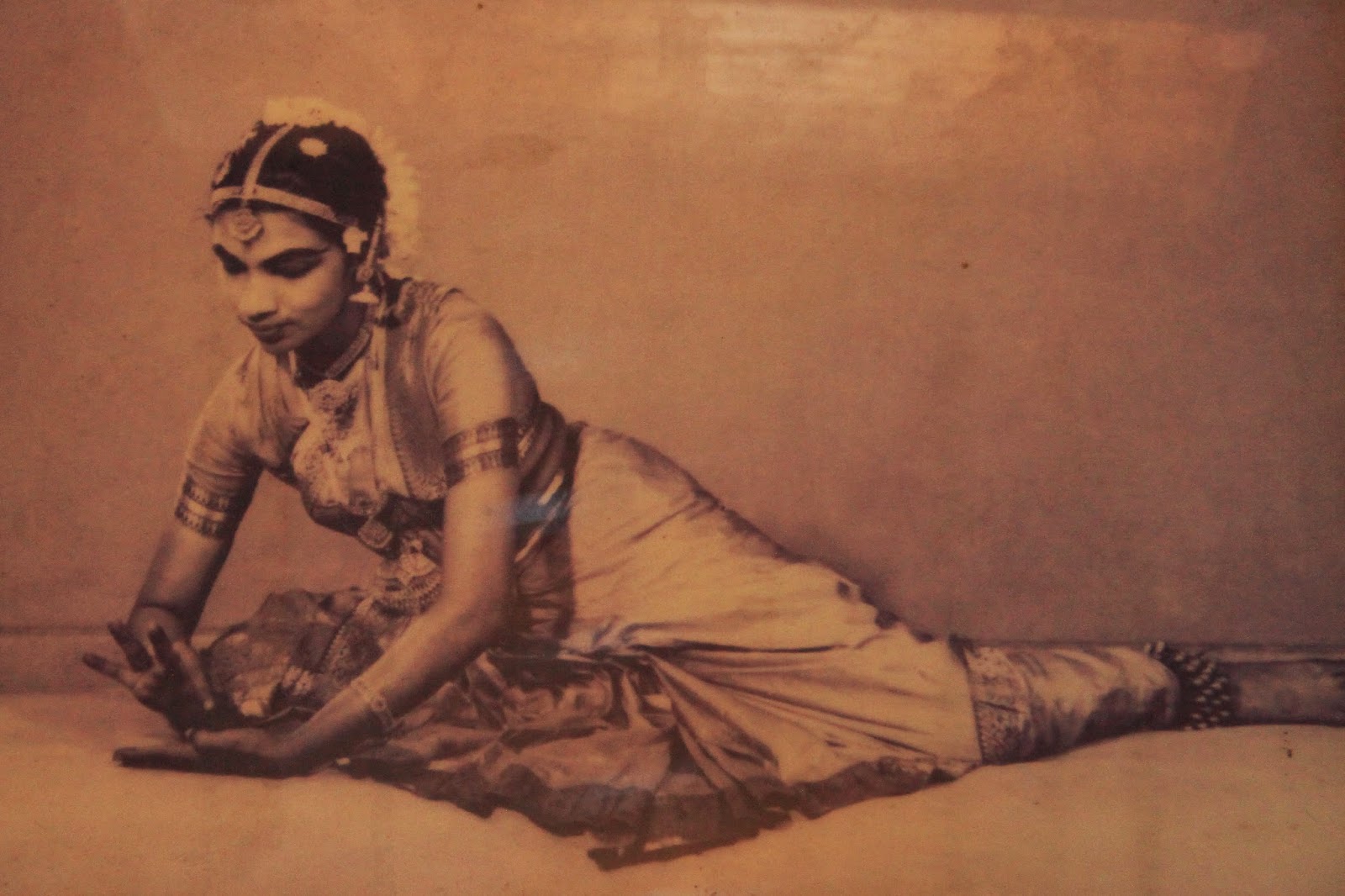
She was just five years old. It was a Thaipongal Day, she remembers, when she saw a wonderful dance by a small Tamil girl at Hettimulla tea estate where her father was working as a superintendent. “I was amazed by her steps and I still remember how I wanted to dance like her,” Hemalatha, now in her late 70s recalled what inspired her to learn dance. When she was young, dancing was belittled by people of high caste. Therefore, she did not receive the blessings of her family when she chose to study dance. “My parents were fond of singing; we used to sing playing Serpina in the evenings. But they didn’t consider dance as a respectable profession,” she said.
While receiving school education from Panadura Good Shepherd Convent, she applied for the dance course in College of Fine Arts (Rajaye Kalayathanaya). Out of the thousands of applications received, she was fortunate to be accepted as one of seven students who received admission in 1954. Some say that the university struggles commenced in 1961. Yet, Miranda claimed that the first university rebellion was in 1957 which resulted in the appointment of the Kularatne Commission.  
“As a student, I was annoyed at the corruption and how people took advantage of the troubles faced by students at the College of Fine Arts. We formed a group and went to the parliament to meet the Prime Minister. We sat on the staircase of the parliament and swore that we wouldn’t get up till we met him,” she reminisced how they were promised what they asked for; a commission of full authority over the Fine Arts College.
She also remembered the service rendered by the late Sri Lankan ballet master, Premakumara Epitawala and renowned musician Sunil Shantha. “Situation of our arts field would have been worse if not for people like them who committed themselves to their work,” she said.
Miranda was a rebellious character at the university, at work as well as an artiste. She fondly recalled the memories when she put herself in trouble trying to do the right thing. “I always say that I am Miranda in The Tempest, Shakespeare’s play. I’m always in a violent windy storm and I always will be. Miranda is still in the tempest,” she laughed.
Meanwhile she also took classes under veterans Shesha Palihakkara and Ganganatha Master to study Barata Natyam, Kathakali and Manipuri dance. “If we were to rebel we had to become strong and confident in the subjects we study. Therefore we all became committed to studying the subjects in depth,” she said. Going to India as the first Colombo Plan scholar in 1963, Miranda’s Arangetram in India had been organized by the leading Indian musician Maturai Krishnon.
She believes that the stigma of dancers in society lifted with the international recognition Sri Lankan dance received. Yet, she said that with the emergence of the television this established reputation started to deteriorate again. “Dance we see today on television is not meant for aesthetic sensations. It aims for something else,” she condemned the semi-nude costumes used by most dancers.
“We cannot blame the private TV channels. They are money oriented. Yet, the two national television channels can’t telecast everything without control. They depend on people’s money. They have to give what is best for the people, without following private media blindly,” she emphasized.
Miranda criticized the artistes who sided with political parties for their personal benefits. “Although I didn’t get on stage in any political party meetings, I believe that I have done my part for the country as an artiste,” she claimed. She believes priests and artistes should not get involved in party politics, they should always consider themselves beyond.
She stressed the importance of nurturing a child’s personality and pointed out how the current education system disrupts the development of personality instead. “If a child’s personality is nurtured, he or she will grow up to be a youth with high self-esteem and self-respect and will have a strong backbone,” she said. “Unfortunately, their personalities are being destroyed from the beginning”.
Speaking further about the personality of the youth today she brought up a conversation among a group of university students, which she happened to overhear. They were having a discussion about new job appointments and they weren’t certain whether those who have maximum qualifications will get the jobs. “I heard one saying that this is their fate. I was shocked by this response, that they were ready to take up anything given to them by the authorities. Should this be the response from the youth?” she raised a question. “They don’t have the courage to fight for their rights. This is one of the reasons behind the downfall of our country,” she added.
She expressed her sorrow at the university and school education system. “University is a place where a student seeks knowledge with the guidance of lecturers. It is sad that today, there are university students who have never set foot in the library while being undergraduates,” she said adding that once the child’s personality is crippled through the school education system it cannot be reconstructed through university education.
She pointed out the weaknesses in the school curriculums, teachers’ manuals as well as the school based assignments and practical tests. “Some of the officials who write teachers’ manuals have third class degrees. How can you make people with third class degrees responsible for education?” She noted that reforming the education system in the country will not be an easy task. “I hope the new government will not repeat these mistakes,” she said.

Miranda reiterated the necessity of a control in selecting teachers for schools as mentioned earlier in the interview. She also said that practical training programs for teachers also play an important role in shaping a successful teacher. She remarked that it is important that the school examinations and administration are in responsible hands. “Without producing a generation of qualified teachers, it will be impossible to redevelop the education system of the country,” she stressed. 

Pic by Ravindra Dharmathilake